The Serola Difference in Sacroiliac Belts (SI Belts) Explained

The Serola SI Belt stands apart from all other sacroiliac joint belts because it is the only belt designed to effectively normalize the function of the sacroiliac joint. Most belts compress the pelvis and help stabilize the joint to make users feel good, but the Serola Difference lies in materials, durability, fit, compression quality, and the ability to promote true healing.
What Are Sacroiliac Belts Designed to Do?
What a sacroiliac belt is meant to do is act like an external ligament when the internal sacroiliac ligaments are torn.
Ligaments do two things:
- they stop the joint from opening beyond normal range of motion.
- when injured, they direct the muscles to contract to take pressure off themselves.
Elastic and Non-Elastic for Effective SI Joint Healing
Basically, there are two different aspects of sacroiliac belts, elastic and non-elastic.
- Non-elastic layers are essential for limiting excessive joint movement.
- Elastic layers provide comfort and mimic muscular compression.
The Serola SI Belt uses both: a non-elastic base layer to stop excessive motion, and an elastic layer for comfort and controlled compression.
Why Are Non-Elastic Sacroiliac Belts Without Buckles Better?
Historically, many believed that the sacroiliac joint didn’t move in adults. Based on this old-school thinking, SI belts were designed to lock the SI joint entirely using buckles, applying significant pressure to prevent all movement.
But this “lock it down” approach is problematic. Excessive compression can harm nerves and blood vessels around the joint. The truth is that movement—within a normal range—is necessary for joint health and healing.
This is where non-elastic materials come in and why non-elastic matters. The Serola SI Belt’s non-elastic layer is applied tightly enough to limit the joint’s motion to a healthy range. It acts like a ligament, providing a safe stop point at the end of normal motion. Importantly, it has no buckle, so it can’t be overtightened. The added elastic layer goes on top, offering gentle compression and comfort.
Role of Elastic Layers in SI Joint Belts
To compress the joint, the ligaments use the muscles. In a damaged joint, whether it’s too loose or too tight, the ligaments direct the muscles to contract to help stabilize it and, with continuous contraction, circulation decreases, toxins build up within the muscles, and the muscles eventually become painful.
Elastic mimics the muscles, in that it gives compression and resilience. It feels good and contributes to stability by pulling the SI joint together. However, elastic doesn’t provide a stop point at the end of motion. So, during certain movements—like bending, lifting, or twisting—the SI joint can still move too far and re-injure the ligaments.
There are two types of elastic used in SI belts, knitted and woven. The difference lies in how they are made and their resulting strength and durability.
- Knitted elastic is lighter, weaker, and less durable. It stretches more and may be see-through when pulled.
- Woven elastic is stronger, denser, and better for applications that need strength and recovery.
Even among knitted elastics, there’s a wide range of quality. But even the best knitted elastic falls short compared to woven elastic for sacroiliac support. Cheaper elastic might seem like a good deal, but it often lacks durability and proper rebound.
Some SI belts that are popular online don’t hold up well to closer inspection. That’s why many of these brands don’t appear at professional trade shows where people can compare products side-by-side. These belts might feel supportive at first, but they rarely match the Serola Belt in comfort, stability, or longevity.
The elastic I use for the Serola SI belt is woven. It is made with many fine rubber strands running along its length. It is dense, durable, and built to withstand heavy-duty use—perfect for long-term sacroiliac joint support. It is the longest lasting elastic.
Hypoallergenic Base Materials Prevent Slippage
The Serola SI Belt has a patented urethane foam that is thin and very durable. I have never seen one wear out. The entire urethane surface is tacky, or sticky, so it stays in place better than any other belt, which is very important in preventing the belt from slipping up.
Other belts may use rubber netting or silicone strips, which can slip or irritate skin. Earlier Serola belts used netting, but this was replaced due to quality concerns. I searched and found the current urethane foam, which is patented to be denser, tackier, more durable, and hypoallergenic enough to use in medical applications where body contact is needed.
Long-Lasting Hook and Loop Fastening for SI Belts
A hook-compatible material is flame laminated onto the urethane. Both layers have four-way stretch that helps the belt adapt to the shape of the body. We sew a strip of loop to:
- Make the base layer non-elastic.
- Provide a strong, long-lasting attachment (about 10,000 to 15,000 uses – how many years is that?).
It has superior peel strength, sheer strength, and tension strength, while being easy to pull apart by hand. Here’s what proper hook and loop looks like:
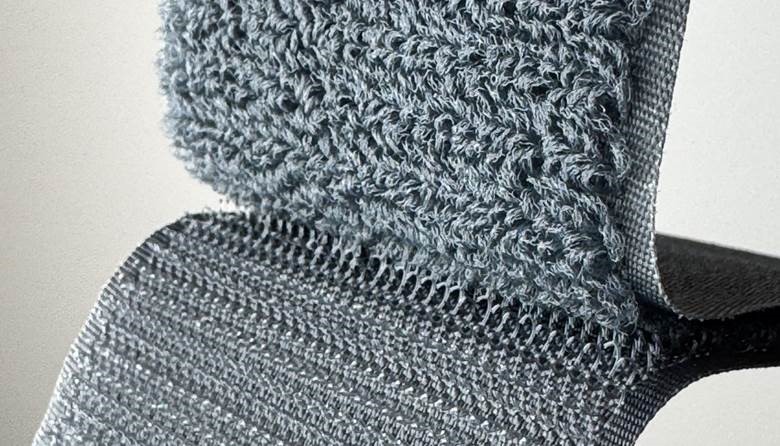
Figure 1: Hook & Loop used in the Serola Sacroiliac Belt
Every manufacturer makes their loop specifically to their hook, so one manufacturer’s hook won’t work as well with other manufacturers’ loop. You lose some function when you mix and match.
Much worse is that many SI belts use hook compatible material, fuzzy stuff, such as fleece or felt, that doesn’t last long at all, sometimes only weeks. This forces people to replace their belts often. Ironically, this leads many to discover the Serola SI Belt. They try a different brand, like how it feels at first, but once it breaks down, they start looking for something better—and find us.
Proven Serola Belts’ Longevity in Daily Exercise
In two months prior to this writing, we have had three people tell us that their Serola Sacroiliac Belts lasted between 10 and 12 years. They used it almost daily for exercise. We don’t guarantee that yours will last that long, it’s a great example of how durable the Serola Belt can be.
In contrast, some other belts have questionable build quality. The base layer on some SI belts has a bad odor. Some reviewers claim it smells toxic. You can’t tell from a picture, so be aware. You get what you pay for; cheap is cheap.
Proper SI Belt Placement for SI Belts
The ideal position of an SI belt is below the Anterior Superior Iliac Spine (ASIS – the bumps at the front sides of the pelvis) and above the top of the leg bone (trochanter), a 2-inch space (see figure 2). While the Serola Belt is 3 inches wide, its functional 2-inch loop fits perfectly in this space. The extra inch cushions the edges, preventing skin irritation (see Figure 3).
If a belt is too wide, it will press in on the widest part of the pelvis, which will cause the lower pelvis to flare outward, stressing the lower SI Joint. It may feel good at first but will gradually aggravate the ligaments.
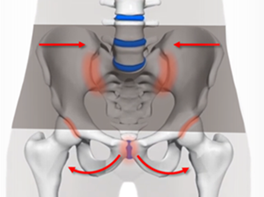 Figure 2: Wide Sacroiliac Belt |
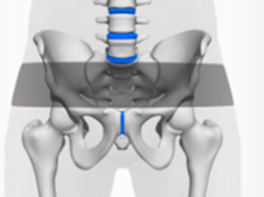 Figure 3: Serola Sacroiliac Belt |
Serola: Designed for Patients, Proven by Professionals
After making some discoveries in back pain treatment, I developed my back support belt for my patients. It was important to me to make the best belt possible, so I put a lot of research and testing into making it. I am very proud of it. My reputation depends on it.
I didn’t start out to make money on my belt. Actually, it was just the opposite because when my belts helped my patients get better faster, they needed less treatment from me.
Since I developed my belt years ago, awareness of the sacroiliac joint as the main cause of back, hip, and leg pain has grown considerably. Many other belts came on the market. The competition is fierce. You may see other belts out there for half the cost of the Serola Sacroiliac Belt, but now you know why.
The Serola SI Belt is recommended by chiropractors, physical therapists, and medical doctors in over 50 countries—professionals who understand sacroiliac joint dysfunction and SI joint pain relief.
The Serola Difference in Summary
- The Serola Sacroiliac Belt’s patented design makes it the only belt that effectively normalizes the function of the sacroiliac joint. Normal function allows proper healing.
- Non-elastic layer mimics action of ligaments and provides a stop point at the end of normal range of motion.
- Elastic layer provides compression to help pull the Sacroiliac Joint together and correct posture.
- No irritating buckles or pads
- Takes the place of the ligaments, not the muscles, therefore improving muscle function and strength throughout the body.
- Made of the highest quality materials to ensure stability, durability, comfort, and value.
- Provides relief for sacroiliac related problems, including back, hip, and leg pain.
- It’s science that makes the difference…the Serola Difference!
Ready to support your recovery the right way? Choose the belt trusted in 50+ countries by healthcare professionals. Learn more about the Serola Sacroiliac Belt!